Aza-Cope Rearrangement : Mechanism| Examples | Application
Aza-Cope Rearrangement Mechanism, Examples and Applications

Organic Chemistey for JEE|NEET|GATE|NET
rearrangement reaction organic chemistry | rearrangement reaction ppt | examples of rearrangement reaction | rearrangement reaction example | pinacol rearrangement reaction
Aza-Cope Rearrangement Mechanism, Examples and Applications
Baker-Venkataraman Rearrangement is the base-promoted (KOH) rearrangement of aromatic 2-acyloxy ketones to the corresponding aromatic 1,3-diketone (β-diketones)
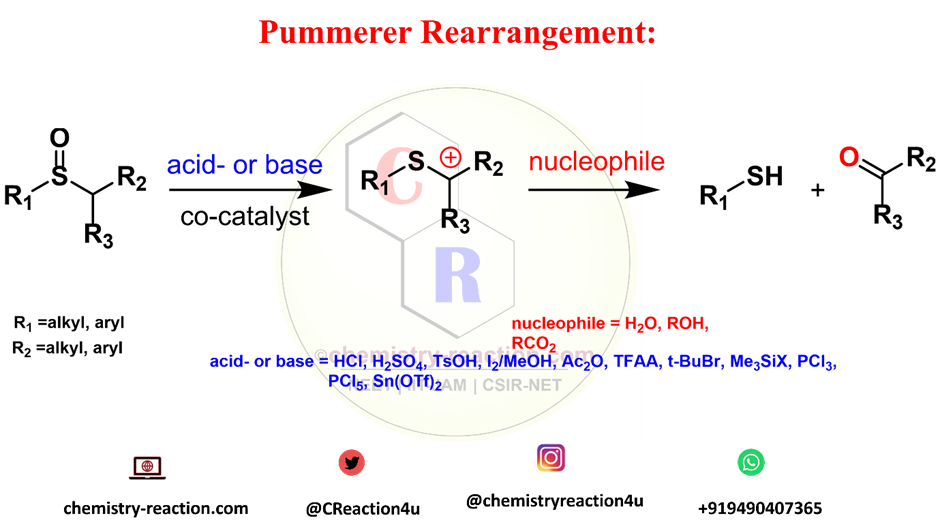
Formation of α-substituted sulfides from the corresponding sulfoxides (must have at least one hydrogen atom at their α-position) is referred to as the Pummerer rearrangement.
The rearrangements reactions are important Name reaction in organic chemistry. Wittig rearrangement, first reported by G. Wittig and L. Löhmann in 1942, The Wittig rearrangement converts α-metalated ethers to metal alkoxides, yielding secondary or tertiary alcohols. Its nitrogen analog, the aza-Wittig rearrangement, transforms α-metalated tertiary amines into rearranged metal amides, producing homoallylic secondary amines. This … Read more
The Carroll Rearrangement is a named reaction in organic chemistry, where the [3,3]-sigmatropic rearrangement of allylic β-keto esters to form γ,δ-unsaturated ketones is called the Carroll rearrangement. It is also known as the Kimel–Cope or decarboxylative Claisen rearrangement. Here, we will explore the Carroll rearrangement and its mechanism, accompanied by some interesting examples. Carroll Rearrangement … Read more
The Aza-Claisen rearrangement is a chemical reaction involving a nitrogen atom’s migration from one position to another within a molecule. It is named after the Claisen rearrangement, a well-known rearrangement reaction involving oxygen atoms. The mechanism of the aza-Claisen rearrangement: The mechanism of the aza-Claisen rearrangement involves three steps: Protonation: The reaction often starts with … Read more